
What Is Beeswax? How Bees Make It and How It Becomes a Candle
What is beeswax? Beeswax is a wax made by honeybees themselves. Young worker bees produce it from small glands on their abdomen and use it to build the honeycomb in which they store honey and raise their brood. After the honey harvest, beekeepers melt and filter the comb, and the result is the firm, dense wax used for candles, polish and much more. This is where beeswax comes from, what it is made of, and how it ends up in a candle.
LLIOR is a Dutch candle brand that makes unscented candles from a 50/50 blend of beeswax and soy wax, with a cotton wick and no paraffin, added fragrance or dye.
What is beeswax made of?
Beeswax is made mostly of esters: compounds of long-chain fatty acids and long-chain alcohols. It also contains free fatty acids and a small share of hydrocarbons, but it is made entirely by the bee, from the sugars in honey.
Chemists have taken beeswax apart in detail. Roughly speaking, about two thirds is esters of various kinds, around 14% hydrocarbons and around 12% free fatty acids, with smaller amounts of alcohols and other compounds. The best known single component is triacontanyl palmitate, an ester of palmitic acid. You do not need any of this to enjoy a candle, but it explains why beeswax behaves the way it does: those long molecules pack tightly together, which makes the wax firm and gives it a relatively high melting point of about 62 to 64 °C.
How is beeswax made by bees?
Beeswax is made by young worker bees, which secrete it from eight wax glands on the underside of their abdomen. The wax appears as tiny, thin scales that the bees chew and shape into comb.
The process is remarkably precise:
- The glands. A worker bee has four pairs of wax glands on the underside of her abdomen. They are most active early in her adult life and gradually shrink as she gets older and spends her days flying out to forage.
- The scales. Each scale is about 3 mm across and only 0.1 mm thick. It takes around 1,100 of them to make a single gram of wax.
- The warmth. Bees only produce wax when the hive is warm, at about 33 to 36 °C. They cluster together to keep that temperature.
- The shaping. The bees pass the scales to their mouths, chew them until they are soft and workable, and press them into the familiar hexagonal cells.
Why do bees make wax?
Bees make wax to build their comb, which is both their larder and their nursery. Honey is stored in the cells and capped with a thin layer of fresh wax, and the queen lays her eggs in cells of the same comb.
Wax is costly for a colony. The bees turn the sugars from honey into wax inside their bodies, and a widely cited experiment found that it took roughly 6.7 to 8.8 kg of honey to produce 1 kg of wax. That is one reason beeswax is a precious material: every kilo represents a great deal of work by a great many bees.
How is beeswax harvested?
Beeswax is harvested as a by-product of honey. When beekeepers extract honey, they slice off the wax caps that seal each cell; those cappings, together with old or surplus comb, are melted down and filtered to remove debris.
Raw comb contains much more than wax: traces of honey, pollen, propolis and the remains of the hive's daily life. The wax is therefore rendered, which simply means melted gently, often in water, so that the clean wax rises and the rest can be separated. It is then strained or filtered and left to set in blocks or pellets. Beeswax should not be overheated; above roughly 85 °C its quality starts to change, so careful rendering takes time.
How is beeswax made for candles?
For candles, beeswax is used once it has been rendered and filtered, so that it is clean and free of debris that could interfere with the wick. The candle maker then melts it again, sometimes blends it with another wax, and pours it into a mould around the wick.
That is exactly how our pillars are made. We melt beeswax together with soy wax in equal parts, pour the blend by hand around a cotton wick and let each candle set slowly. Why we combine the two is explained in Beeswax and Soy Candles: Why We Blend the Two.
What is beeswax used for?
Beeswax is used for candles, wood and leather polish, cosmetics such as lip balm and creams, food wraps, cheese coatings, and in crafts from encaustic painting to lost-wax casting. In the EU it is also an approved food additive, E901, used as a glazing agent.
Candles are one of the oldest uses. For centuries, beeswax candles were the finest light available, used in churches and wealthy households, while most people made do with tallow. Today beeswax sits alongside many other candle waxes, from soy and rapeseed to paraffin. If you are curious how they all compare in origin, we gave an overview in What Are Candles Made Of?
Why is beeswax good for pillar candles?
Beeswax suits pillar candles because it is firm and dense at room temperature and melts at a relatively high temperature. A freestanding candle needs that structure to keep its shape, its edges and any detail pressed into the wax as it burns.
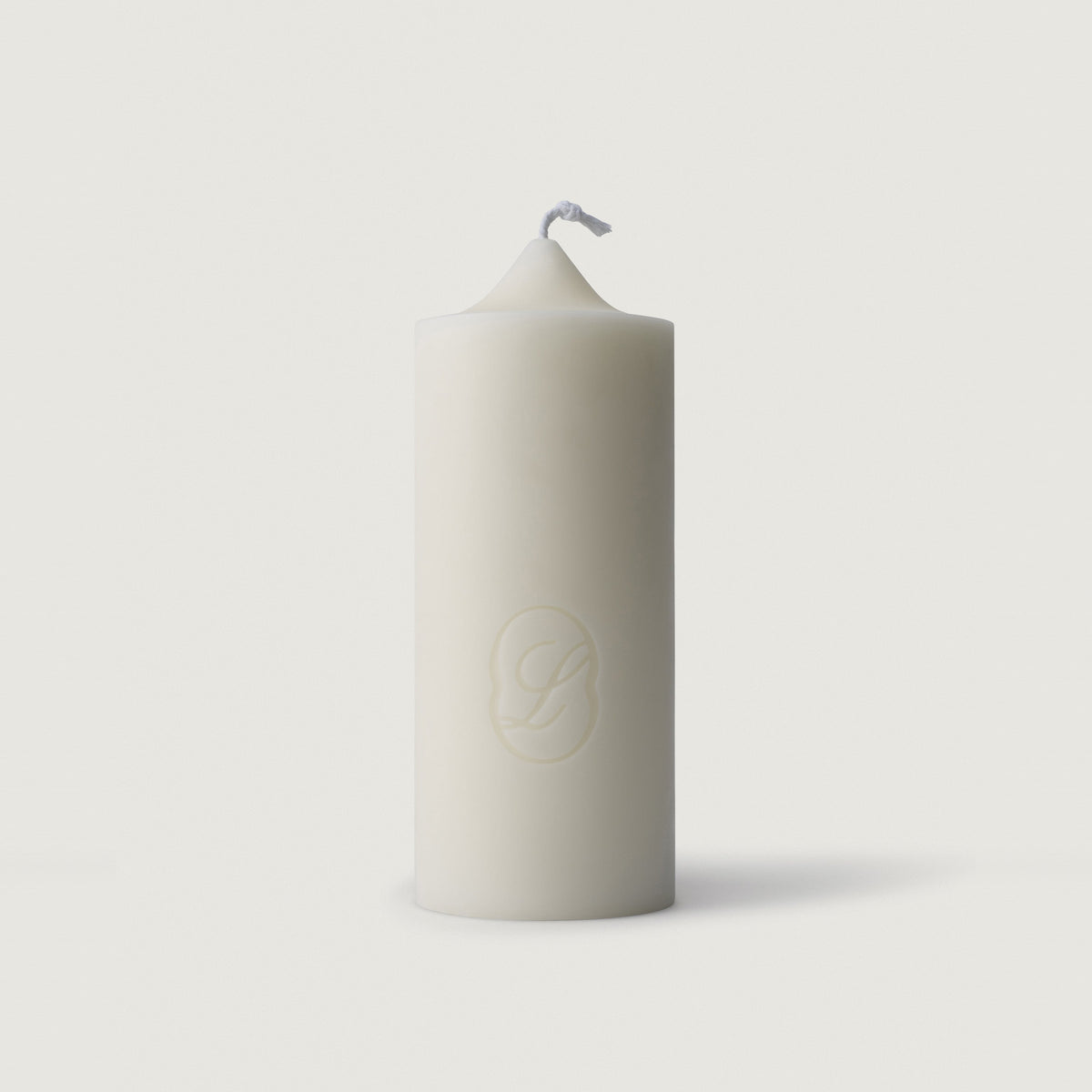
A pillar has no jar to hold it together. It has to stand on its own for many hours of burning, and the wax at its outer wall has to stay solid while the centre melts around the flame. Beeswax gives our blend that backbone. The Signature Candle is the clearest example: 20 cm tall, 8 cm across and 800 g of wax, with a measured burn time of 180 to 200 hours and the monogram still crisp in its side.
Caring for a candle with beeswax
A candle with beeswax is cared for like any good pillar: trim the wick to 0.5 to 1 cm before each burn, let the first burn last at least two hours, and burn for no more than four hours at a time.
Keep the candle away from draughts, on a stable, heat-resistant surface, and never leave it burning unattended. A snuffer puts the flame out without bending the wick. Our guide on how to trim a candle wick has the details.
Why we work with beeswax
A candle is made of very few things, so every material is a choice. Beeswax is one of the oldest candle waxes there is, made by bees from the sugars in honey and gathered by beekeepers after the harvest. We like that its origin is so easy to picture: a hive, a comb, a summer of work. Together with soy wax and a cotton wick, without paraffin, added fragrance or dye, it is all our candles are made of. You can see them in the collection.
Frequently asked questions
Where does beeswax come from?
Beeswax is produced by honeybees from the sugars in honey. Beekeepers collect it after the honey harvest and melt and filter it to remove debris from the hive.
What is the melting point of beeswax?
Beeswax melts at about 62 to 64 °C, which is why it stays firm and dense at room temperature.
How much wax does a bee make?
Very little. Each wax scale is about 3 mm across and 0.1 mm thick, and it takes around 1,100 scales to make one gram of beeswax.
Are LLIOR candles made of pure beeswax?
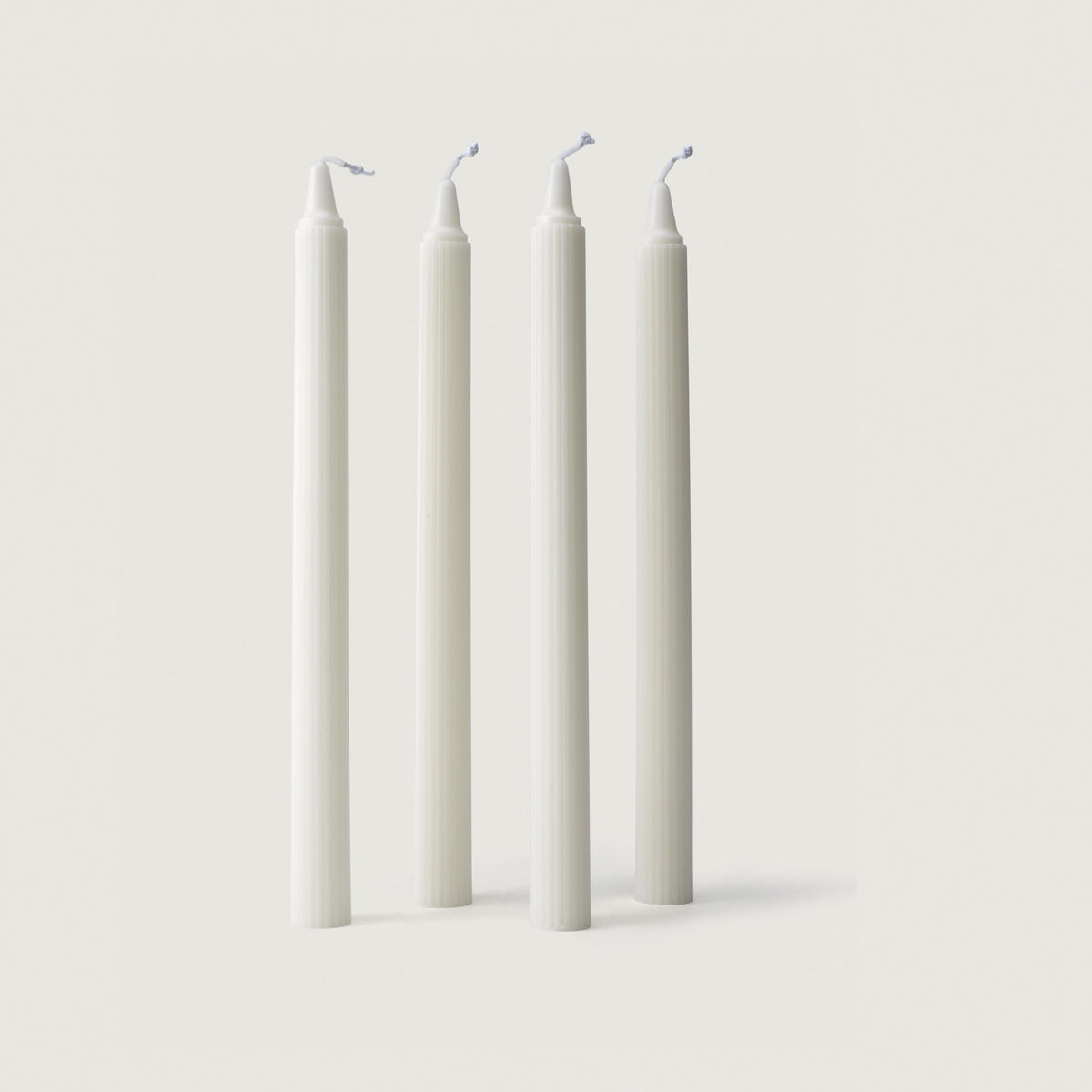
No. Our pillars are poured from a 50/50 blend of beeswax and soy wax with a cotton wick. Our Four Tapers are poured in soy wax.
Do your beeswax candles have a scent?
We add no fragrance to any of our candles. They are made to give light, not scent. More in Unscented Candles.

Read more
What are candles made of? Wax and a wick, and often fragrance, colour and hardeners on top. A plain guide to every candle ingredient and wax type, and why ours are made of beeswax, soy and cotton a...
If strong smells bother you, the simplest candle is one with nothing added. What fragrance-free really means, what to check on the label, what an unscented candle smells like, and how to enjoy cand...