
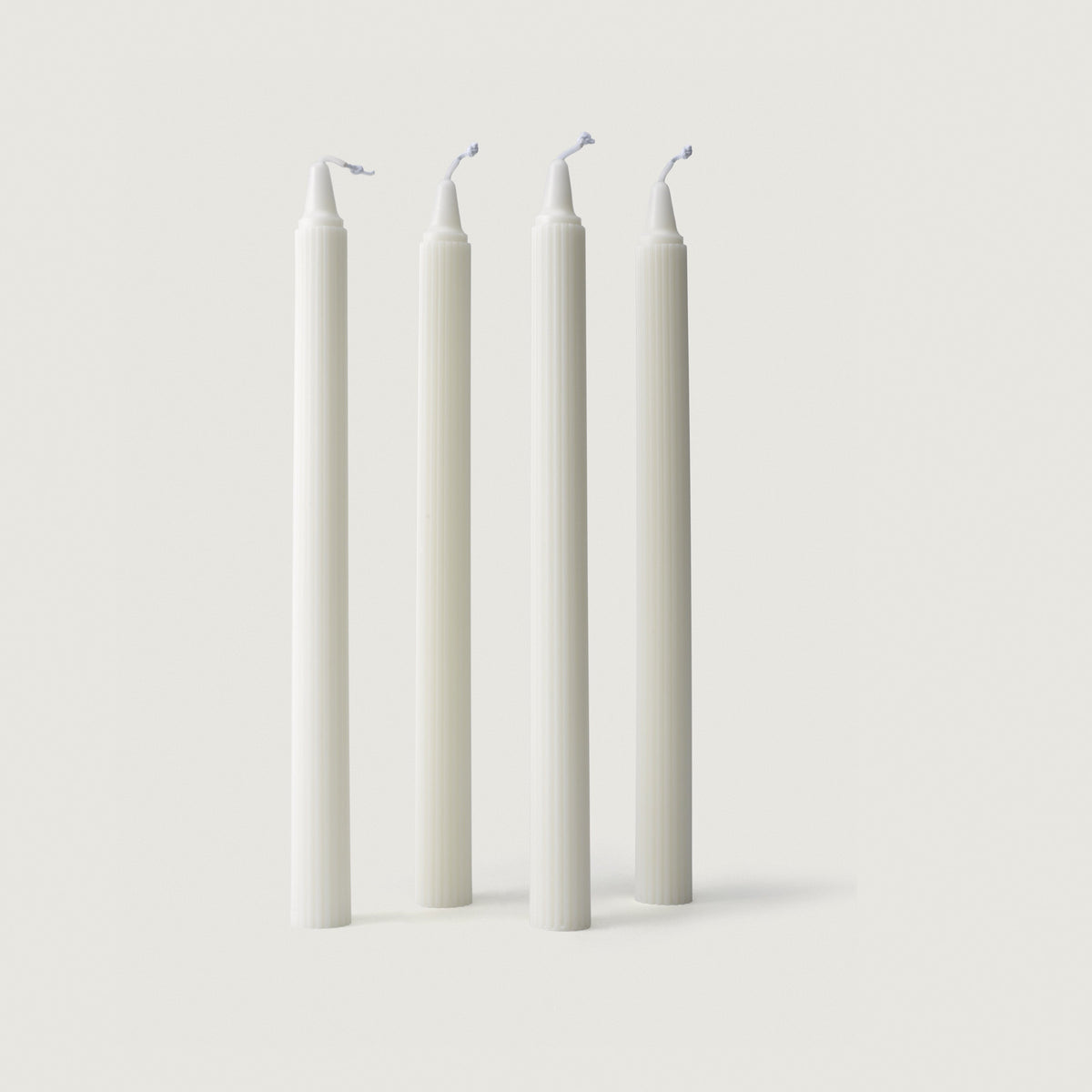
What Is Paraffin Wax Made Of, and Where Does It Come From?
Paraffin wax is the most widely used candle wax in the world, and also one of the least explained. It appears on labels as "paraffin", "mineral wax" or simply "wax", and most people have never been told what it is or where it comes from. This guide answers that plainly: what paraffin wax is made of, how it is produced, what else it is used for, and why our own candles are made without it.
What is paraffin wax?
Paraffin wax is a white, odourless, solid wax made from crude oil. Chemically, it is a mixture of hydrocarbons, and it is soft enough to melt in a candle flame and firm enough to hold its shape at room temperature.
That combination is what made it so useful to candle makers. It can be poured, moulded and coloured easily, and it is produced in large, consistent quantities. In candles, it is the default wax rather than the exception.
What is paraffin wax made of?
Paraffin wax is made of hydrocarbons: molecules built from nothing but carbon and hydrogen, typically with 20 to 40 carbon atoms each. These are straight-chain molecules from the same family as the gases and fuels refined from crude oil, only much longer, which is why they are solid at room temperature.
The name says something about its character. It comes from the Latin parum affinis, "having little affinity", because paraffin reacts with very little.
Where does paraffin wax come from?
Paraffin wax comes from crude oil. It is a by-product of refining lubricating oil, separated out as a waxy fraction and then cleaned and refined into a solid wax.
In simple steps, the process looks like this:
- Refining. Crude oil is separated into fractions at a refinery. The heavier fractions are used to make lubricating oils.
- Dewaxing. Those oils contain wax that would make them thicken in the cold, so it is removed. What comes out is a soft, oily mixture called slack wax.
- De-oiling. The slack wax is mixed with a solvent and cooled, so the wax crystallises and can be filtered away from the remaining oil.
- Finishing. The wax is treated to remove colour and odour, then blended to a chosen melting point and hardness for its use.
The less oil that remains in the wax, the more refined it is said to be. Paraffin wax was first described by the German chemist Carl Reichenbach in 1830, and within a few decades it had become a common material for candles.
Is paraffin the same as petroleum, kerosene or petroleum jelly?
No, though they are relatives. All of them come from crude oil, but each is a different fraction with a different form and use.
- Paraffin wax is the solid wax used in candles, crayons and coatings.
- Paraffin, in British English, often means the liquid fuel that Americans call kerosene. In Dutch, the same fuel is called petroleum, which adds to the confusion.
- Liquid paraffin, or paraffin oil, is a clear mineral oil, used for example in cosmetics and for oiling wooden boards.
- Petroleum jelly is a soft, semi-solid blend of oils and waxes, somewhere between the oil and the wax.
So when a label says paraffin, it means a material from the oil industry, refined into a form that suits the product.
What is paraffin wax used for?
Candles are the best-known use, but paraffin wax appears in many everyday things:
- candles, tea lights and crayons
- coatings for cheese and waxed paper
- cosmetics, and the warm paraffin baths used in manicures and pedicures
- a glazing agent on some foods, listed as E905
- electrical insulation and industrial coatings
The reason is the same everywhere: it is stable, has no smell of its own and can be made in large, uniform batches.
What is the melting point of paraffin wax?
Most paraffin wax melts at between about 46 and 68 °C. Manufacturers choose a grade within that range to suit the product, a softer grade for a candle in a jar and a firmer one for a candle that has to stand on its own.
How can you tell if a candle is made of paraffin?
Read the label. A candle that does not name its wax, or says only "wax", "candle wax" or "mineral wax", is very often paraffin or a blend that includes it. Waxes such as beeswax, soy wax or rapeseed wax are usually named, because makers who use them want you to know.
We go into the details, including the words to look for, in Paraffin-Free Candles: How to Tell if a Candle Is Paraffin.
Why don't LLIOR candles contain paraffin?
Because we wanted to know, and be able to say, exactly where every part of our candles comes from: wax from bees and from soybeans, and a wick of cotton.
LLIOR is a Dutch candle brand that makes unscented candles from a 50/50 blend of beeswax and soy wax, with a cotton wick and no paraffin, added fragrance or dye.
Paraffin comes from oil. That is not a judgement, simply its origin. Our choice was to start from different materials and keep the list of ingredients as short as it can be: wax and wick. You can read more about that thinking in The Principle, or see it in its simplest form in The Signature Candle, 20 cm tall, 800 g of beeswax and soy, and 180 to 200 hours of light.
Frequently asked questions
What is paraffin wax made of?
Paraffin wax is made of hydrocarbons: molecules of only carbon and hydrogen, typically with 20 to 40 carbon atoms each. It is obtained from crude oil.
Where does paraffin wax come from?
Paraffin wax comes from crude oil. It is separated from the waxy fraction left over when lubricating oil is refined, then de-oiled and refined further.
What is the melting point of paraffin wax?
Most paraffin wax melts at between about 46 and 68 °C, depending on its grade and how much oil it still contains.
Is paraffin the same as kerosene?
Not quite. In British English, paraffin can mean the liquid fuel also called kerosene. Paraffin wax is the solid wax; both come from crude oil, but they are different fractions.
Do LLIOR candles contain paraffin?
No. LLIOR candles are made from a 50/50 blend of beeswax and soy wax, with a cotton wick and no paraffin, added fragrance or dye.

Read more
A candle burns for as long as it has wax to give the flame. Here is what burn time means, what makes a candle burn faster, how long to burn it at a time, and how long our candles last, from 6 to 8 ...

How to put out a candle properly: why a snuffer is the calmest way, how to put a candle out without blowing it, and what to do with the wick afterwards so a natural wax pillar keeps burning evenly.