
Where Does Candle Wax Go When You Burn It?
Candle wax does not disappear when you burn a candle: it becomes fuel. The flame melts the wax, the wick draws it up, the heat turns it into vapour, and that vapour burns into water vapour and carbon dioxide, giving off heat and light. A candle that gets shorter is wax that has gone up, as gas, into the flame.
Updated 20 November 2026
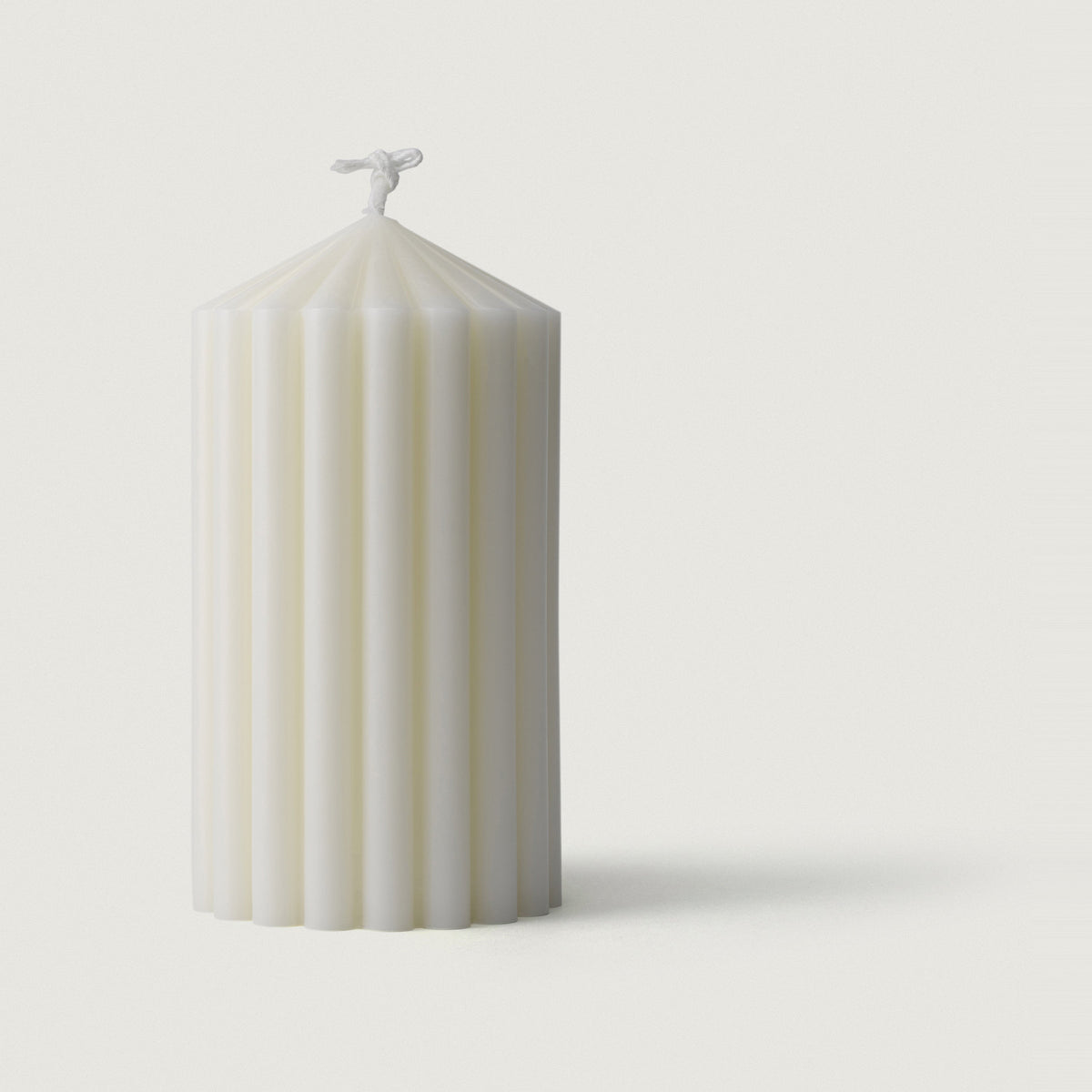
You can work out how fast that happens with The Signature Candle: 800 g of wax and a measured burn time of 180 to 200 hours. That is roughly 4 g of wax an hour, burning quietly away in the flame.
Where does candle wax go when you burn it?
It burns. Almost all the wax that reaches the wick leaves the candle as water vapour and carbon dioxide.
Candle wax is made mostly of carbon and hydrogen. In the flame they combine with oxygen from the air: the carbon becomes carbon dioxide, the hydrogen becomes water, in the form of vapour. Both are invisible gases. That is why there is no pile of leftover wax, only a candle that slowly grows shorter.
What comes out of the flame even weighs more than the wax that went in, because oxygen from the air joins it. The physicist Michael Faraday devoted a whole series of Christmas lectures in London in 1848 to exactly this question: what happens inside a burning candle.
Where does the wax go when a candle burns? Step by step
In four steps: melting, drawing up, vaporising and burning.
- Melting. The heat of the flame melts the wax just below it into a shallow pool.
- Drawing up. The liquid wax rises through the fibres of the cotton wick, the way water rises through a paper towel.
- Vaporising. Near the top of the wick the wax is hot enough to turn into a gas.
- Burning. That gas burns with oxygen. It gives light and heat, and the heat melts more wax.
How the wick does its part is explained in How Does a Candle Wick Work?
How much wax does a candle burn per hour?
It depends on the candle. A Signature Candle of 800 g with 180 to 200 burn hours uses about 4 g of wax an hour on average.
A slim candle is finished sooner; a wide candle with plenty of wax around the wick lasts longer, simply because there is more fuel. The table shows how it goes with the Signature, worked out from its weight and measured burn time. These are averages: draughts, wick length and how long you burn each time all make a difference.
| Burn time | Wax burned | Wax left in the candle |
|---|---|---|
| 2 hours (first burn) | about 8 to 9 g | about 791 g |
| 4 hours (one evening) | about 16 to 18 g | about 783 g |
| 50 hours | about 200 to 220 g | about 580 to 600 g |
| 100 hours | about 400 to 440 g | about 360 to 400 g |
| 180 to 200 hours | practically all of it | the candle is finished |
For how long other candles last, from tapers to large pillars, see How Long Does a Candle Burn?
Where does candle wax go when it melts?
Nowhere. Wax that melts without a flame, on a warming plate or in the sun, sets again and stays wax.
Wax only turns into gas in the heat of the flame, at the top of the wick. A candle that melts without being lit does not get any lighter: the wax just changes shape.
Where does the wax go when a candle drips?
Wax that runs down the side never reaches the wick, so it does not burn. It stays on the holder or the table.
Dripping happens mostly in a draught, with a wick that is too long, or with a slim candle that stands at an angle. Trim the wick to 0.5 to 1 cm before every burn and keep the candle out of draughts, and the wax stays in the pool around the wick, where it belongs. More in Why Do Candles Drip? If it has already happened, here is how to remove candle wax.
How do you make sure the wax burns well?
With four habits: keep the wick short, give the first burn enough time, do not burn too long in one go, and put the flame out gently.
- Wick at 0.5 to 1 cm. Trim it before every burn. A long wick feeds too much wax to the flame.
- First burn of at least 2 hours. This gives the pool of melted wax time to spread across the top.
- No more than 4 hours at a time. Let the candle cool before you light it again.
- Use a snuffer. The Snuffer lets the flame go out calmly and keeps the wick upright for next time.
What is LLIOR candle wax made of?
Beeswax and soy wax, in equal parts, around a cotton wick. Nothing else goes in: no scent, no colour, no paraffin.
LLIOR is a luxury candle brand from Amsterdam that makes natural, unscented design candles from beeswax and soy wax, poured by hand, with a cotton wick and no colour.
So what goes up into the flame is wax. There is nothing more to it: no scent to smell, no colour to see, only the form and the light.
From LLIOR
The Signature Candle, €34: 20 cm tall, 8 cm across, 800 g and 180 to 200 burn hours. Edition No. 01, €88: the whole collection in a numbered set, more than 330 burn hours together. Prices at the time of writing. We ship within the EU.
Why LLIOR
We want to make the most beautiful natural candle in Europe. So we leave out everything that does not need to be there.
Natural. Beeswax and soy, in equal parts. A cotton wick. No scent, no colour, no paraffin. Wax and wick: that is the whole list.
Long. The Signature Candle burns for 180 to 200 hours, measured. A whole winter of evenings.
By hand. Every candle is poured by hand, in small batches. Designed in Amsterdam.
To look at. Design candles, beautiful even when unlit.
To give. Without scent, you never guess wrong. That is why people give LLIOR to the ones they love.
We believe you should know what you light. See the collection.
For the full picture, read our guide to natural candles.
Frequently asked questions
Where does candle wax go when you burn it?
It burns in the flame and becomes water vapour and carbon dioxide, two invisible gases. That is why the candle gets shorter without leaving wax behind.
Does candle wax evaporate?
Yes, but only in the heat of the flame, at the top of the wick. There the liquid wax turns into gas, and that gas burns.
How much wax does a candle burn per hour?
For The Signature Candle, 800 g with 180 to 200 burn hours, about 4 g an hour on average.
Why is there wax left on my candle holder?
Wax that drips never reaches the wick, so it does not burn. A wick of 0.5 to 1 cm and a spot without draughts help.
What are LLIOR candles made of?
Beeswax and soy wax in equal parts, with a cotton wick, and no scent, colour or paraffin.

Read more
The best Christmas gifts for clients suit every recipient and last beyond the holidays. Ideas by budget for clients, employees and partners, from €20 to €88, and how to order with a card.
Christmas gift ideas for him by budget, from 20 to 90 euros: why a well-made unscented candle works for someone who says he needs nothing, and how a snuffer and matches turn it into a complete gift.